Reviewed by Dr. Rodriguez, DC, Infinite Healing Center
You wake up, swing your legs toward the floor, and a white-hot bolt of electricity shoots from your lower back down to your toes. Even tying your shoes or walking to the mailbox suddenly feels like an impossible climb. If you're searching for a chiropractor for sciatica in Mesa, you're likely caught between the fear of permanent nerve damage and the high-stakes prospect of spinal surgery.
You don't have to accept either. At Infinite Healing Center, Dr. Rodriguez and our team focus on resolving the underlying nerve compression at its source — combining chiropractic care, physical therapy, trigger point injections, and spinal decompression into one coordinated plan, rather than treating sciatica with a single tool in isolation.
Sciatica is more than back pain — it's compression of the body's longest nerve, which is what creates that electric-shock sensation down the leg. Dr. Rodriguez tailors technique to each patient, primarily using the diversified technique, with Thompson Drop and Activator methods brought in based on tolerance and severity. Most sciatica cases at IHC resolve without ever needing an MRI. And because sciatica typically involves muscular, mechanical, and neurologic components together, combining therapies tends to outperform any single approach for chronic or recurring cases.
Sciatica isn't a single diagnosis — it's a set of symptoms caused by an underlying condition, usually lumbar radiculopathy. It occurs when the sciatic nerve, the longest and thickest nerve in the body, becomes compressed or irritated. That's different from a dull ache: it's the sharp, burning, tingling sensation of actual nerve entrapment, often traveling in a line from the lower back straight down to the toes.
Many patients are surprised when something as small as picking up a pencil or sneezing triggers a debilitating flare-up. Often, the spine has been drifting out of alignment for months or years — that small movement is just the final straw on a system already at its limit. In Mesa, the L4 through S1 nerve roots — where the lower spine meets the pelvis — are the most common sites of the compression driving chronic leg pain.
This nerve bundle emerges from the lower spine and travels deep through the buttocks and down the back of each leg. Because it's so large, even a single millimeter of disc bulge or a minor spinal misalignment can create significant distress. It's also important to distinguish true sciatica, which originates at the spinal cord, from Piriformis Syndrome — a similar-feeling condition caused by a muscle in the buttock compressing the nerve rather than the spine itself. A proper evaluation is what tells the two apart.
Pills can't move a misaligned vertebra or decompress a bulging disc — they quiet the signal without addressing what's causing it. Long-term reliance on anti-inflammatories also carries real risk to the digestive system and kidneys. Real relief requires correcting the mechanical source, which is what allows the nerve to actually heal rather than just go quiet for a few hours.
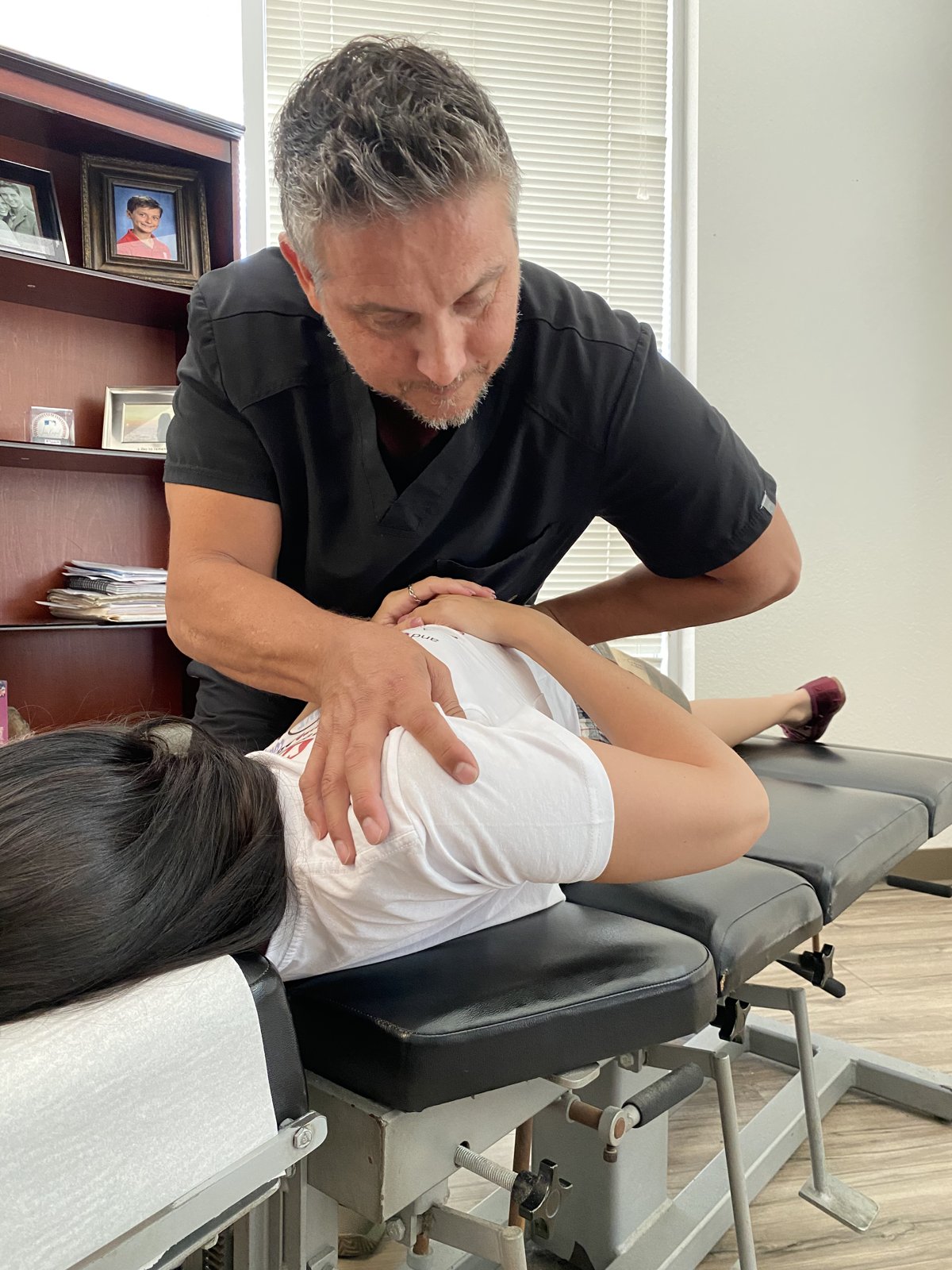
When a vertebra shifts even slightly out of place — a subluxation — it creates direct mechanical pressure on the nerve roots exiting the spine, which is the primary driver of shooting leg pain. Dr. Rodriguez's approach is built primarily around the diversified technique, a widely-used method for restoring proper joint motion and alignment. Depending on a patient's tolerance and the severity of their case, that's combined with gentler options — the Thompson Drop technique or an Activator adjustment — rather than a one-size-fits-all approach. Someone in acute, guarded pain is treated differently than someone managing a longer-standing case.
The pelvis is the foundation for the entire spine. When it's tilted or rotated, the lumbar vertebrae are forced to compensate, creating uneven disc pressure and nerve entrapment. Restoring the spine's natural lumbar curve stabilizes the whole structure and helps prevent the next flare-up, not just resolve the current one.
Spinal discs have no direct blood supply — they rely on movement itself (a process called imbibition) to pull in nutrients and flush out waste. When a joint is stuck or misaligned, the disc it supports begins to dehydrate and degenerate, often leading to the bulges that press on the sciatic nerve. Restoring proper joint mechanics helps reverse that cycle rather than just numbing the result of it.
Chronic and recurring sciatica rarely comes from one problem alone — it's usually a mix of muscular, mechanical, and neurologic factors working together. Treating only one of those pieces tends to produce partial, short-lived relief. That's why IHC's care plans combine the strengths of physical therapy, chiropractic adjustment, trigger point injections, and spinal decompression into a single coordinated plan rather than picking one tool and hoping it's enough.

Shane, our PT tech, guiding an assisted stretch — physical therapy and chiropractic care work in tandem to treat sciatica
Severe pain often causes the surrounding muscles to guard and contract defensively. These hyper-irritable trigger points can be strong enough to pull a freshly-adjusted vertebra back out of alignment within days. Trigger point injections address that piece directly — relaxing the muscles that are clamping down around the spine so an adjustment has a real chance to hold.
For herniated or bulging discs, spinal decompression offers a non-surgical alternative to the operating room. A specialized table applies gentle, computer-controlled traction to the lumbar spine, creating negative pressure within the disc that helps draw protruding material back into place, away from the nerve root — without the cutting, risk, or long recovery of a surgical discectomy.
Your first visit starts with a comprehensive history and neurological evaluation to map your specific pain pattern, followed by functional testing of leg strength and reflexes to gauge the degree of nerve involvement. From there, Dr. Rodriguez builds a treatment plan matched to your case — which technique combination, and in what sequence.

Relief care focuses on calming the immediate nerve irritation; corrective care addresses the structural instability that caused the flare-up in the first place. Acute cases can resolve quickly. Chronic or recurring cases generally take longer, since retraining the supporting muscles and stabilizing the joints is a slower process than simply reducing pain. Age, activity level, and how long the condition has been present all factor into your specific timeline — which is why the evaluation exists, rather than a generic estimate.
1. History & Neurological Evaluation — Mapping your specific pain pattern before anything else.
2. Functional Testing — Leg strength and reflex testing to gauge nerve involvement.
3. Personalized Care Plan — Dr. Rodriguez selects the right technique mix — diversified, Thompson Drop, or Activator — based on your case.
4. First Treatment — Your care begins the same day, not on a follow-up visit.
An integrated clinic offers something a single-service office can't: your chiropractor, physical therapy team, and injection specialists working from the same chart, in the same building. No miscommunication between separate providers, no shuttling between offices. Since 2004, that's been the model at Infinite Healing Center — treating sciatica as a mechanical, muscular, and neurologic problem that deserves more than one tool.
Schedule your sciatica evaluation
It depends on the severity of the compression and how your body responds to care. Many patients notice meaningful relief within the first few weeks; full structural stability — retraining the muscles that support the spine — typically takes longer. Your evaluation with Dr. Rodriguez will give you a realistic, personalized timeline rather than a generic estimate.
Yes — chiropractic care, combined with spinal decompression, is a well-established non-surgical option for herniated discs. Decompression creates negative pressure within the disc that helps draw protruding material away from the nerve root, avoiding the risks and recovery time of surgery.
Not usually. Fewer than 10% of sciatica patients at IHC end up needing one, since a comprehensive neurological evaluation and, when needed, digital X-rays are often enough to build an effective care plan. MRI is reserved for cases where symptoms aren't responding as expected or a more complex issue is suspected.
General lower back pain is typically localized to the lumbar region and involves muscle strain or joint stiffness. Sciatica means the sciatic nerve itself is compressed, causing pain that radiates down the leg — often a sharp, electric or burning sensation rather than a dull ache. The distinction matters because nerve-related pain needs a different treatment approach than muscle soreness alone.
They can, if they increase pressure on a herniated disc — deep forward folds, for instance, can push disc material further toward the nerve. It's worth getting a professional evaluation before starting a home stretching routine, so you're doing movements that decompress the spine rather than aggravate an already irritated nerve root.
We do our best to accommodate acute flare-ups — call the Mesa office as early as possible to check same-day availability.
Many plans cover chiropractic adjustments and physical medicine services, though coverage varies. Bring your insurance information to your first visit and our team will run a complimentary benefits check so you know what's covered before treatment starts.
Ignoring ongoing nerve compression can lead to lasting nerve damage or muscle weakness in the legs over time, and the body often develops compensation patterns that create secondary problems in the hips and knees. Since roughly 90% of the sciatica cases seen here resolve without needing an MRI when addressed early, getting evaluated sooner rather than later tends to mean a shorter, simpler path back to normal.